Common house spiders (Parasteatoda tepidariorum) are also known as American house spider or more commonly as just a ‘house’ spider. While there are many spiders you can find inside a home, many of those may or may not always want to be there. This arachnid actually prefers to live near to or in a humans dwelling. Even though this spider lives in such close proximity, it often comes as a surprise to the homeowner who moves some furniture and finds a well established web complete with eggs sacs and many dead insects strewn about. The common house spider is very comfortable in living with you and me.
What Does The Common House Spider Look Like?
It is fairly easy to identify a common house spider. Its appearance is most often dullish shades of brown in color with some spotting or varying patterns. Their bodies are at least a 1/4 of an inch and at most an inch in size with legs extended and are similar to the widow spiders in shape. It prefers to build its web in undisturbed areas often only inches from everyday human activity. Such areas include behind couches, under furniture, in corners of bookcases, behind doors to name just a few. A tell tale sign of the common house spider is the presence of many dead bugs on the ground just beneath the web. Once captured prey is fully consumed or gone dry, the common house spider will cut the body out of the web and allow it to fall below. A good exterminator often gets valuable information as to what’s been visiting your home by seeing what this spider has been eating.
Are Their Bites Harmful?
Just like all spiders, the common house spider only bites when threatened. This spider has a neurotoxin venom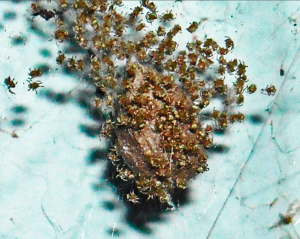 similar to the black widow but the house spider is not as venomous and very often their bites to humans are ‘dry’. Usually the most you can get from a bite is itching and swelling, but it may also trigger allergies in a more sensitive victim. This spider can live for about 1 year and a single female can produce up to 17 sacs in her lifetime and each sac can hold as many as 400 babies.
Control Of The Common House Spider
A vacuum with hose end attachment is probably the most effective and sure way to eliminate the common house spider. Residual insecticides can be used on common house spiders, but one has to make sure that the spider makes contact with the treatment or else it will be rendered ineffective. Wettable powders can help as it can be applied onto webs, where they will stick and ensure that the spider makes contact with it. Efforts to seal up the home can help but tiny spiderlings can just about be impossible to keep out of even the most sealed homes.